
AI spine healthcare
SPINEPILOT
Ask. Evidence answers.
The world's first evidence-based AI clinical copilot, built for spine care.
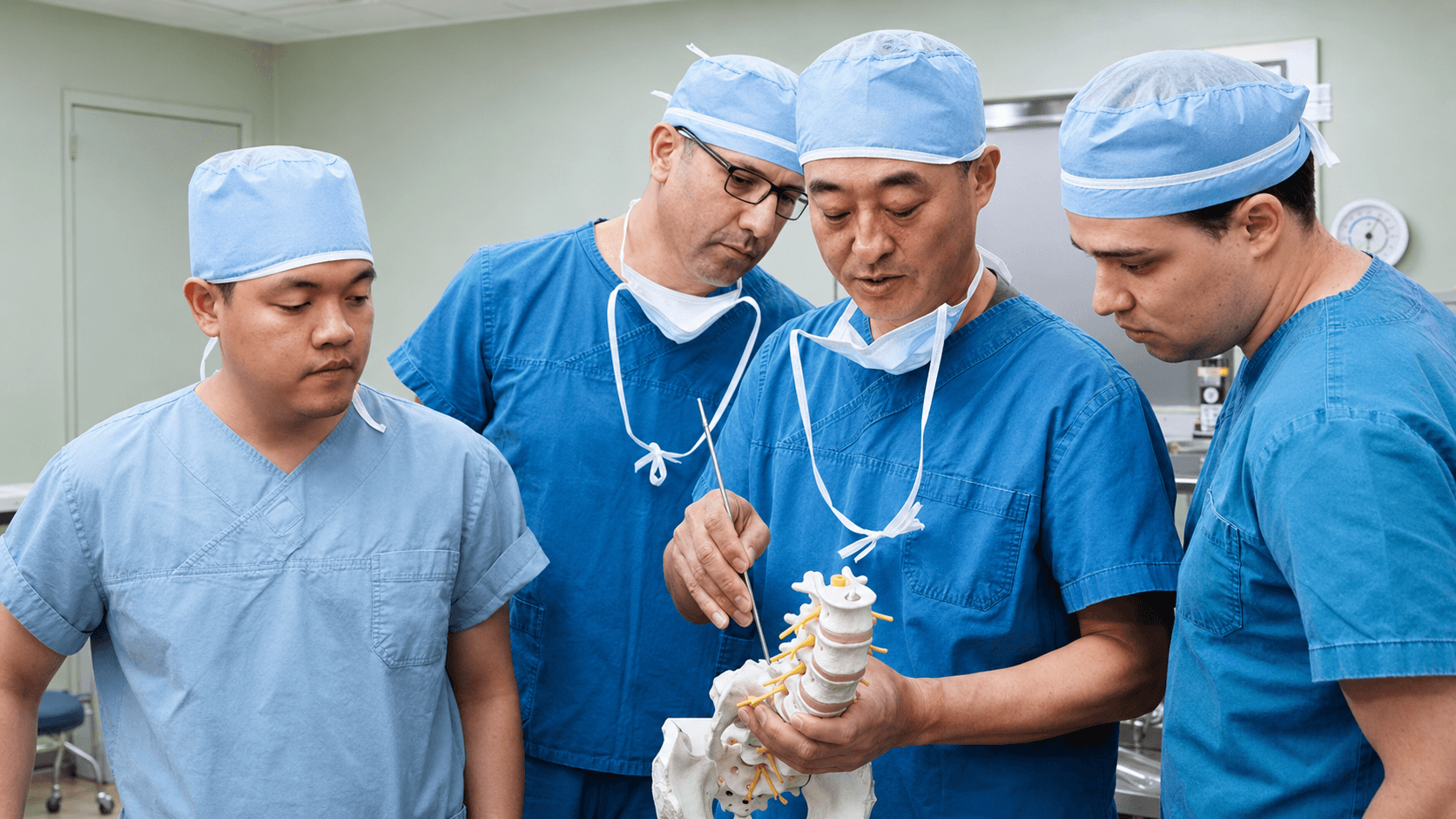
Structured from 30 years of clinical practice, 20,000+ spine surgeries, and 50,000 consultations.
THE PROBLEM
Common spine pain, overwhelming clinical workload
Patient volumes are high and consultation time is short. Physicians must bring fragmented imaging, test results, and history together before making a decision.
619M
people live with low back pain: the world's #1 cause of disability.
Source: WHO, 2023
1h : 2h
For every hour with patients, nearly two hours of paperwork.
Source: Annals of Internal Medicine, 2016
5 min
That's what the problem that matters most gets.
Source: Tai-Seale et al., Health Services Research, 2007
WHERE THE KNOWLEDGE COMES FROM
Built from real clinical practice—not generic internet knowledge
SpinePilot starts with clinical experience accumulated in a real hospital and the judgment of spine specialists.

0
Years of practice
0+
Spine surgeries
0+
Consultations
0+
Clinical records structured
0+
Radiology reports
All of it, structured.
HOW IT WORKS
Ranked differential diagnoses with evidence
Enter one clinical question. SpinePilot searches guidelines and real patient journeys, then presents the top three differential diagnoses in probability order—with citations one click away.
01
Ask
One clinical question, in plain language.
02
Retrieve
Clinical guidelines + real patient journeys.
03
Cite
Every claim carries its source.
04
Answer
Top-3 differentials, ranked with probabilities.
Retrieving · guidelines + real patient journeys
01
It searches instead of imagining
Watch what SpinePilot reads before it answers: a clinical guideline corpus, the patient care-pathway knowledge graph, and the red-flag rule engine.
Top-3 differential diagnoses with probabilities
02
Three likely diagnoses, ranked
The top three differential diagnoses with probabilities, with evidence IDs and similar patients cited right in the answer.
NASS guideline · relevance-scored
03
A source for every answer
Open any citation to see the source, year, and evidence text, inside the app, one click away.
VERIFIABILITY
Evidence you can verify, answer by answer
SpinePilot does not ask for blind trust. It makes verification part of the workflow.
Each statement links to a clinical guideline or a real patient pathway, so physicians can inspect the source in one click without leaving the care workflow.

SAFETY
When risk is detected, the AI stops and alerts the physician
When SpinePilot detects a red flag such as tumor, infection, or cauda equina syndrome, it withholds the answer and prioritizes physician review.
Red Flag Queue · physician-in-the-loop review
Pending · AI answer withheld
A red flag was detected, so SpinePilot withheld its answer. No differential diagnosis is offered until a physician completes the review.
Physician first.
Withheld cases enter a review queue and reach a physician before any answer is shown.
69%
of cauda equina claims allege diagnostic error or delay.
Source: Emergency Medicine Journal, 2023
THE ENGINE
Not generated — retrieved
SpinePilot searches textbooks, clinical guidelines, and real patient pathways. A spine knowledge graph links symptoms, imaging, diagnoses, treatments, and outcomes to the evidence behind each answer.
Knowledge graph architecture
Symptoms, imaging, diagnoses, treatments, and outcomes are connected as traceable care pathways.
Patient pathway explorer
The same graph, running in SpinePilot: node details and similar patient pathways, with similarity scores.
Wrong level, wrong side: rejected.
A metadata filter drops evidence that doesn't match the spinal level, side, or urgency, before it can reach the answer.
It never leaves the hospital.
SpinePilot runs on-premise. Patient data stays inside the hospital network, by design.
PRODUCT
One engine, two modules
The world's first evidence-based AI clinical copilot, built for spine care.
Spine clinical AI platform
SpinePilot
The spine clinical AI engine

For Clinicians
SpineDX
Research-use, non-medical AI clinical decision support for physicians, launching in March 2027. It supports review of ranked differentials, cited evidence, similar cases, and draft documentation. Final judgment remains with the physician.

For Patients
SpineCheck
A non-medical wellness guide that helps patients organize symptoms, recognize urgency, and choose the next step. It does not provide a diagnosis and is scheduled to launch in March 2027.
Everything needed for the visit, on one screen
Designed with spine specialists to keep the essentials visible in a time-limited consultation.
Built for five languages
A five-language interface prepared for global rollout.
THE COMPANY
The spine AI company behind SpinePilot
AllThatSpine Co., Ltd. is a spine-focused AI research and development company founded in Pohang, Korea, in 2023. We connect clinical knowledge, specialized data, and engineering research to transform spine diagnosis, education, and care management.
Product provider
AllThatSpine Co., Ltd.

SPINE AI R&D
From clinical reality to verifiable spine AI
Our advantage is not a single model. It is a connected research system that carries clinical questions through data, engineering, and physician-centered validation.
Spine clinical knowledge
Thirty years of clinical experience and real patient journeys define the questions worth solving.
Spine-specialized data
Clinical records, imaging reports, and guidelines are structured and quality-controlled for research.
Applied AI research
Knowledge graphs, evidence retrieval, and safety guardrails are integrated into usable products.
Physician-led validation
Specialist review and external evaluation check evidence quality, performance, and safety.
Research focus · SpineDX · SpineCheck · spine clinical data infrastructure
PERFORMANCE
Pre-launch performance validation targets
The products are launch-ready, with verification targets of 70% Top-3 concordance, 90% red-flag sensitivity, and answers under 5 seconds.
70%
Top-3 diagnostic concordance
90%
Red-flag sensitivity
<5s
Response time (P95)
≥90%
Evidence-retrieval precision
Pre-launch performance targets · accredited third-party verification (KOLAS) is scheduled with sealed test sets.
The category is proven: across 122 randomized trials, clinical decision support improved adherence to standards of care by an average of +5.8 percentage points.
Source: Kwan et al., BMJ, 2020
Standards-aligned: KCD · SNOMED CT · HL7 FHIR · DICOM. Designed to Korea MFDS generative-AI guidance for SaMD.
WHY NOW
Thirty years of expert knowledge, made more accessible
As populations age and spine specialists remain unevenly distributed, clinical knowledge must reach farther.
2.1B
people will be aged 60+ by 2050.
Source: WHO, 2025
80%
of U.S. counties have no neurosurgeon.
Source: Frontiers in Neurology, 2026
11M
health-worker shortfall projected by 2030.
Source: WHO Health Workforce
WHO'S BEHIND IT
Built on real practice
SpinePilot is grounded in the experience of Gun Choi, a globally recognized spine-care authority and master surgeon, together with eight specialists across four countries and six hospitals.

Gun Choi, MD · PhD
Founder & CEO · Director, Pohang Woori Hospital · Secretary-General, WCMISST
30 years · 20,000+ spine surgeries · 50,000 consultations
8 spine specialists · 4 countries
Neurosurgeons and orthopedic spine surgeons from Korea, Japan, Colombia, and India label the gold-standard answer sets.
6-hospital clinical network
A network of clinical partners under MOU, anchored by Pohang Woori Hospital, which operates 114 beds.
POSTECH external validation
Model performance is evaluated externally with POSTECH.
Validated with 800 patients
The Spine GPT foundation was validated with 800 patients in a national Pre-TIPS R&D program.
Leadership
Taejin Kwak, PhD
Vice President & Head of Business
Won-Ki Hong, PhD
Co-founder & CTO · Professor of CS, POSTECH
Partners & neighbors
NEWS
The SpinePilot journey

CES 2027 · Planned global demonstration
Following selection for the Pohang Technopark joint pavilion, a global demonstration of SpinePilot is planned, subject to final organizer approval.

CES 2027 · Selected for the Pohang Technopark joint pavilion
Selected by Pohang Technopark in August 2026. Final organizer approval has not yet been confirmed.

Investment & marketing MOU with Hoogland Spine Products
Strategic partnership with the German spine-device specialist.
Pre-TIPS clinical validation completed
The Spine GPT foundation was validated with 800 patients in a national R&D program.
See SpinePilot in action
Request a product briefing or a partnership conversation with our team.
Get SpinePilot updates